vicky virgin
dancer, researcher, choreographer
Life Lessons Gleaned from the Ballet Barre
Written during the COVID-19 pandemic
March 2020-2022
Preface
In March of 2020 everything went dark. Sirens provided the 24/7 soundscape. In an instant, ballet dancers all over the world were reduced to tiny computer screens. Space, a quintessential element of dance, became whatever one could muster. Dancers were stranded, clinging for dear life onto anything to hold onto—a door knob, kitchen counter, the back of a chair--desperate to maintain a practice that is embedded in the DNA of any ballet dancer. The daily ballet barre. Living in NYC during the first few months of the pandemic brought this decades-old practice into high relief. It was in these dark moments that I understood how this practice has set me up for life. Not only how to dance, but how to survive a pandemic.
Lesson #1: How to achieve a passé balance en relevé
Balance by definition is stability, equilibrium. In the realm of movement, this becomes complicated because when moving, balance is never static but always in flux. The dancer is the steward.
-
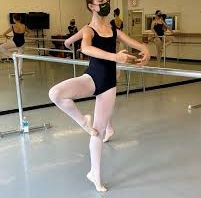
Achieving a passé balance en relevé or half-toe has little to do with physical strength. Yes, it is predicated on a good physical structure. But you cannot muscle it. Instead, it presents a beautiful dialectic: strength/weakness, hard/soft. For example, if the chest is tense, the energy flow stops there and can’t reach its natural destiny which is up through the head and out into the universe. Yesterday I attained a balance that had such clarity! It was effortless and weightless. For perhaps eight seconds, I was floating above it all. (Figure 1.)
Figure 1
-
The feet are the primary building blocks. First and foremost, they must be relaxed, soft and released into the floor. Nothing can happen without this important physical understanding in place. With hips squarely placed over fully stretched knees, you rise to relevé allowing the spine to take over.
-
The architecture of the body in this moment resembles a skyscraper, the epitome of straight, strong and vertical. However, this structure must be able to obey the will of the wind. For the dancer, this is where the pliancy of the muscles come into play, creating the elemental principal of flow.
Reflection: Today, I could not find my balance. Troubling because I equate physical balance with mental balance. In the context of a pandemic, when everything has been turned upside down, this takes on powerful new meaning. How do we right ourselves, or should we even try?
Lesson #2: The beauty of repetition
Repetition is integral to many movement studies. Done properly, you can learn about the relationship you have with your body, your history, your person, and your limits. It is a study of your very existence.[1]
The tendu offers a perfect example: It is one of the core movements of all of ballet steps (See Figure 2.). It teaches dancers to move the feet and legs correctly, introduces the transfer of weight from one foot to the other, and helps to build strength and control. It is a deceptively simple movement and the building block of the ballet vocabulary as it leads to more and more complex movements. If you don’t get this right, you won’t get very far. I estimate that I have done over one million tendus in the course of my ballet training.
Figure 2.
Each repeat presents an opportunity to learn something new.
-
How to go deep: The movement must be done with the purest intention, methodically, with full consciousness. Doing the same movement over and over again and again in a meticulously disciplined way offers an entry point to go deeper than ever imagined, deep into the skeletal and musculature that is unique to your physical structure. Nothing is more important than to be in dialogue with your body because only in listening will you ever know yourself. Your body never lies. Ask the question…where are you holding tension in your body, right no
-
How to face yourself: Repetition teaches you how to be comfortable being uncomfortable and embrace the beauty of being vulnerable--exposed with nowhere to hide and everything to learn. You must be absolutely present in the moment in order to achieve this state. Doing the same thing over again and again instills the very important habit of being present.
-
How to establish a discipline: The ritual of the repeat provides the space that allows you to practice intentionality. Of this practice, a discipline is born and you are set on the pathway to the meditative zone where all sense of time and place cease.
Reflection: Doing tendus today I noticed my weight was way back on my heels. Where is the message in this? Am I afraid to be out in the front, to push forward, to face the future, tomorrow, today? Will this plague ever go away?
Lesson #3: Arabesque—the most exquisite line
Ballet, as an art form, is all about line-line created by the human body. Because dance relates to space, usually the stage, the principles of “presenting” the body are foundational. Dancers are taught to visualize their body as a paint brush creating a three-dimensional painting. This concept is embedded in the training of any ballet dancer. Exercises executed daily at the barre are designed to create muscles that are long and lean exactly for this purpose.
Arabesque a la seconde is one of the most sublime lines. It slices through the air like Augustus Saint-Gauden’s Winged Victory. Firmly planted, with guiding principles, gently reaching for the sky but solidly connected to the earth-the planet upon which we rest. It is a very sophisticated and complex line with many countering forces (See Figure 3). The head, the arms, the back, the shoulders, the chest—all in it together. The entire upper body, supple and soft. Hips square and securely placed provide the platform holding it all together.
-
The epitome of grace can be found in this line only if care is taken to keep the arms fluid and pliant. It is a natural flow of energy that comes out through the torso and back. Do not interfere with it or you will lose your line. Remember that the longest line is not necessarily the best. Again, the reciprocal relationship of softness and strength.
-
Focus is imperative. You need to be fully present in order to create this line, a living line full of energy projected out into space. Allow the line to become itself in a manner of pure fulfillment. Energy feeds line follows form becomes line. Poised in the moment, your eyes trained on the horizon, looking into the future. All softness and flow…the ultimate release.
Reflection: Can I find even a glimmer of hope in my second arabesque today?
Figure 3.
Lesson #4: The story of the ballet barre
The legacy of ballet dates to the Sun King, Louis XIV. It was in his court over four centuries ago that ballet, as a system, of movement began. In theory and practice ballet technique has evolved as an iterative process built upon knowledge passing down from generation to generation, teacher to teacher, and dancer to dancer. The ballet barre is a perfect exemplification of this process. There is a studied logic to the order and execution of the exercises used as a warm up to prepare you for the center exercises. You begin slowly, work your way up to a sustained peak of exertion before slowly coming back down and cooling off. Rhythm and timing provide the overarching narrative.
-
You start by facing the barre placing both hands on it…first position, demi plié (See Figure 4.) Slowly you begin stretching and bending the knees, with small upper body and head rolls.
Figure 4.
-
Keeping one hand on the barre, you now face forward and grand pliés begin.
-
Next you are challenged with transferring your weight from one leg to the other by way of the tendu and frappé. The muscles begin to fire in their own time and order. Twenty minutes in and the first sweat breaks.
-
The pace quickens and breathing follows suit. All of the large muscle groups are now called into action requiring full-blown sustained effort. Deep and sweeping movements of the arms, back, and legs ensue.
-
Cooling down begins as the focus now shifts to small and intricate movements of the lower legs and feet. Rhythms become more complicated, stimulating and bringing the brain into play.
-
You end full circle with both hands back on the barre…second position, grand plié.
Reflection: The autumnal equinox began at 9:20 this morning and my mind wanders. I can already sense the pull of gravity as the days shorten and darkness lengthens. This is the tipping point. A sense of release comes over me, the hard work is over, it’s all downhill from here. The duty to strive abates. I surrender to the melancholic and give into a new season.
Lesson #5: Commitment
There is commitment and then there is commitment. The daily showing up is one form of commitment, being on the face of a mountain with nowhere to go but up is another, and then there is the pirouette.
-
Pirouette, the most challenging commitment: It is one of the most complex and physically sophisticated movements in the ballet lexicon. Described as a 360 degree turn in place on one leg, it requires a tremendous amount of coordination and timing. Everything has to come together in that moment. You also need strength, not too much and not too little. Once you set your body in motion, you must commit to it. Commit to it with every molecule in your body. There is no turning back. There is no in-between – you are either all in or not. The double pirouette en pointe is one of the most terrifying things I have ever committed to.
-
Then there is the commitment to showing up each day--to getting out of bed, to washing your face, to putting one foot in front of the other, to facing the barre, to the next breath, to living, to facing the barre, to writing about commitment. To facing the barre?
-
But the ultimate commitment is to the lifestyle you sign onto as a professional ballet dancer. This requires years of training, cultivating a habit of will and discipline, a profound devotion that skitters on the edge of the sacred. The rewards of a strenuous life are many (Figure 5.)
Figure 5.
Reflection: What have I learned about commitment from the ballet barre that can soften the road in the middle of a plague with no end in sight? It’s challenging. Some days I have to keep both hands on the barre just to get through and some days I don’t even make it to the barre.
Lesson #6: The Broader Implications of Dessus Dessous or What is Negative Space?
Negative space as defined by the visual art world is the space around a subject or the space outside. But it is often the “real” subject of an image. But what does it mean in the medium of dance?
-
The canvas for the painter is equivalent to the stage for the dancer. To create line and carve out and through the space with one’s body is the dancer’s raison d’etre. And because dance is married to time, this line is never static or fixed but in constant motion – affected and controlled by the dancer herself as she moves and pushes through the air, sculpting the space. Transforming the space--making the invisible visible. Even in stillness you can see energy emanating from the dancer’s body electrifying the space around her.
-
What is unique about dance as an art form is the process whereby negative and positive space are continually being exchanged. There is no place where it starts and ends. In this actual space/time, energy fields are always in motion, crossing back and forth, repeating and reversing, coming back onto and into, over and under/dessus dessous.
-
The space around the dancer’s body is the dancer’s body – that which lies outside of her and yet contains her. That they are two separate things is nothing but illusion. William Butler Yeats asks “How can we know the dancer from the dance?”[2]
Reflection: So where does it begin and where does it end, this thing we call space? What if there is no border between a dancer’s body and the air she moves in, meaning there is no distinction between positive/negative /, inside/outside but instead a collapsing or expanding and dissolving into one giant harmonious wholeness? What actually happens in the place where negative and positive space mingle in an infinite number of transitory infinitesimal phases?
As the second year of the pandemic begins, I continue to ask these questions. I make note to pay attention to this liminal space, to the energy that is radiated out. How does it affect the atmosphere, the conversation, the world. Move forward through the pandemic and beyond with this notion in mind. Embrace the concept that the body is the vessel to the future.
[1] Ralston, Peter, 1999, Cheng Hsin: The Principles of Effortless Power
[2] Yeats, William Butler, 1928, Among School Children